
The Sun and Stars: A Comprehensive Overview
Our Sun, a typical star among hundreds of billions in the Galaxy, possesses an immense scale. Within a 10 light-year radius, roughly ten stars reside, highlighting the vastness of space.

Stellar luminosity, a fundamental property of stars, describes the total amount of energy a star emits per unit of time. This energy is radiated across the entire electromagnetic spectrum, from radio waves to gamma rays, though visible light constitutes a significant portion. The Sun’s luminosity serves as a crucial benchmark for comparing other stars, allowing astronomers to understand their energy output and physical characteristics.
Understanding luminosity requires considering both a star’s size and its surface temperature. Larger stars generally have higher luminosities, as they possess a greater surface area from which to radiate energy. Similarly, hotter stars emit significantly more energy per unit area than cooler stars, following the Stefan-Boltzmann law.

The Sun, while seemingly constant in its brightness to us, exhibits subtle variations in luminosity. These fluctuations are linked to internal processes, such as sunspots and solar flares, and can impact Earth’s climate. Comparing the Sun’s luminosity to other stars reveals a wide range – some stars are vastly more luminous, while others are considerably fainter. This diversity is a key aspect of stellar evolution and the life cycles of stars within galaxies.
The Sun as a Star
The Sun, often perceived as unique due to its life-sustaining properties, is fundamentally a star – a massive, luminous sphere of plasma held together by its own gravity. It’s classified as a G-type main-sequence star (a yellow dwarf), representing a common type of star within the Milky Way galaxy. Its composition is overwhelmingly hydrogen (approximately 71%) and helium (around 27%), with trace amounts of heavier elements.

The Sun’s diameter, approximately 1.4 million kilometers, is about 109 times that of Earth. Despite its immense size, it’s considered an average-sized star; many stars are significantly larger or smaller. Its mass, however, accounts for roughly 99.86% of the total mass of the solar system, dominating the gravitational influence within our neighborhood of space.
Like all stars, the Sun generates energy through nuclear fusion in its core, converting hydrogen into helium and releasing tremendous amounts of energy in the process. This energy radiates outwards, providing light and heat to the planets orbiting it. Studying the Sun provides invaluable insights into the behavior and evolution of other stars throughout the universe, serving as a readily accessible cosmic laboratory.
Solar Composition and Density
The Sun’s composition is remarkably simple, primarily consisting of hydrogen and helium. Approximately 71% of its mass is hydrogen, while roughly 27% is helium. The remaining 2% comprises trace amounts of heavier elements like oxygen, carbon, nitrogen, silicon, magnesium, neon, iron, and sulfur. These heavier elements, though present in small quantities, play a crucial role in the Sun’s energy production and spectral characteristics.
Despite its enormous size – a diameter 109 times that of Earth – the Sun is surprisingly not very dense. Its average density is only about 1.41 g/cm³, which is approximately four times less dense than Earth. This lower density is a consequence of its gaseous composition and the immense pressure and temperature within its interior.
The Sun’s density isn’t uniform throughout its structure. It’s significantly denser at its core, where nuclear fusion occurs, reaching around 150 g/cm³. Density gradually decreases as you move outwards towards the surface, the photosphere, and then into the extremely tenuous corona. Understanding the Sun’s composition and density is fundamental to modeling its structure and predicting its behavior.
Core Temperature and Energy Production
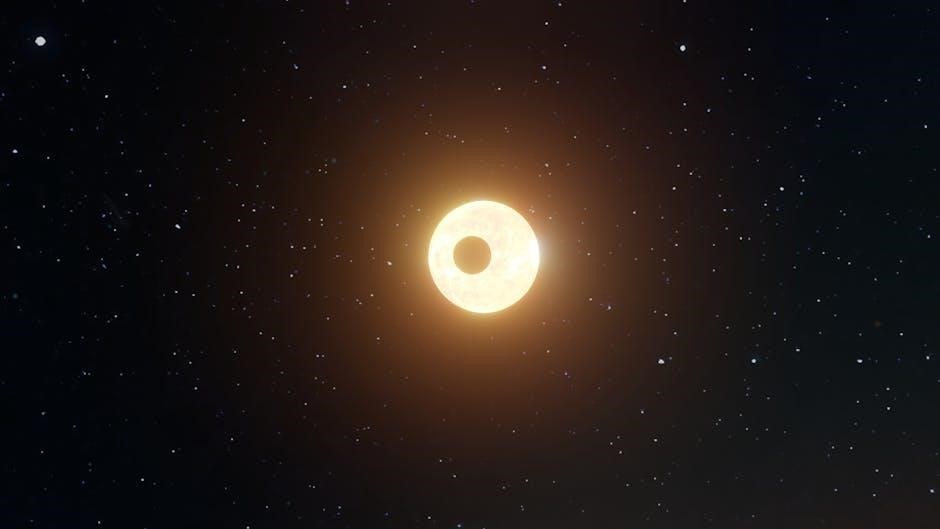
The Sun’s core is an incredibly energetic environment, reaching temperatures on the order of 15 million degrees Kelvin (approximately 27 million degrees Fahrenheit). This extreme heat is essential for initiating and sustaining nuclear fusion, the process that powers the Sun and releases vast amounts of energy.
Energy production occurs through a series of nuclear reactions, primarily the proton-proton chain, where hydrogen nuclei (protons) fuse to form helium nuclei. This fusion process converts a small fraction of mass into energy, following Einstein’s famous equation E=mc². It’s estimated that only about 10-12 times the Sun’s hydrogen abundance is converted into energy over its lifetime.
The energy generated in the core travels outwards through radiative and convective zones. Radiative zone transfers energy via photons, while the convective zone relies on the physical movement of hot plasma. This energy eventually reaches the Sun’s surface, radiating into space as light and heat. The Sun’s sustained brightness for approximately 9 billion years indicates a remarkably stable energy production rate.

Solar Lifespan and Future Brightness
Currently, the Sun is roughly halfway through its main sequence lifespan, having already burned for approximately 4.6 billion years. Projections indicate it will maintain its current brightness for another 9 billion years, providing a stable energy output for a considerable future. However, this stability is not indefinite.
As the Sun ages, it will gradually increase in luminosity. This increase, though slow, will have significant consequences for Earth. Over time, the rising solar output will lead to increased temperatures, eventually causing the evaporation of Earth’s oceans and rendering the planet uninhabitable; The timeframe for this transition is billions of years, but it’s a crucial factor in considering the long-term habitability of our solar system.
Eventually, the Sun will exhaust its core hydrogen fuel, leading to a dramatic shift in its structure and behavior. It will expand into a red giant, engulfing Mercury and Venus, and potentially Earth. Following the red giant phase, the Sun will shed its outer layers, forming a planetary nebula, and ultimately collapse into a white dwarf – a dense, slowly cooling remnant.
Sunlight Intensity: Lux on a Bright Day
Determining precise lux values for sunlight on a bright day is complex, varying significantly based on atmospheric conditions, time of day, and geographic location. However, we can establish a general range. Direct sunlight, when measured perpendicularly, can reach intensities exceeding 100,000 lux. This is far beyond the typical illumination levels experienced indoors.
On a clear, sunny day, with the sun relatively high in the sky, ambient daylight typically falls between 10,000 and 25,000 lux. This explains the sensation of heightened brightness, where even surfaces not directly illuminated appear significantly brighter than usual. The observation of brighter roads corroborates this, as sunlight reflects off surfaces, increasing overall illumination.

It’s important to note that these values represent averages. Cloud cover, haze, and pollution can drastically reduce sunlight intensity. Furthermore, the human eye’s perception of brightness is not linear; therefore, a doubling of lux does not necessarily equate to a doubling of perceived brightness. The dazzling effect experienced today suggests conditions are optimal for maximum solar illumination.
Factors Affecting Sunlight Intensity
Numerous factors modulate the intensity of sunlight reaching Earth’s surface. Atmospheric conditions are paramount; cloud cover dramatically reduces intensity through absorption and scattering of light. Aerosols – tiny particles like dust, pollen, and pollution – similarly diminish sunlight, contributing to haze and reduced visibility. The angle of incidence plays a crucial role; sunlight striking Earth at a shallow angle (sunrise/sunset) travels through more atmosphere, leading to greater absorption.
Geographic location influences intensity, with equatorial regions receiving more direct sunlight than higher latitudes. Seasonal variations, due to Earth’s axial tilt, alter the angle of incidence and day length, impacting solar radiation. Even daily fluctuations occur as the sun’s position changes throughout the day.
Furthermore, the Earth’s distance from the Sun varies slightly throughout the year due to its elliptical orbit, though this effect is relatively minor. Finally, the Sun’s inherent variability – sunspots and solar flares – can cause short-term fluctuations in energy output, though these are typically small and don’t significantly impact daily sunlight intensity.
The Sun’s Diameter Compared to Earth

The Sun’s immense size is difficult to fully grasp without comparison. Its diameter stretches approximately 1.4 million kilometers (864,000 miles). This is a staggering figure when contrasted with Earth’s comparatively modest diameter of roughly 12,742 kilometers (7,918 miles). The Sun is, therefore, about 109 times wider than our planet – meaning you could line up 109 Earths across the face of the Sun.
To further illustrate this scale, over 1.3 million Earths could fit inside the Sun. This vast volume contributes significantly to the Sun’s gravitational dominance within our solar system, holding all planets in orbit. Despite its enormous size, the Sun is actually considered an average-sized star; many stars are significantly larger.
However, the Sun’s substantial diameter is also linked to its relatively low density. While massive, it’s composed primarily of hydrogen and helium, making it about four times less dense than Earth. This combination of immense size and lower density defines the Sun’s physical characteristics and its role as a star.
The Sun’s Energy Source: Nuclear Fusion
The Sun’s radiant energy originates from a remarkable process occurring deep within its core: nuclear fusion. This isn’t combustion, as might be intuitively assumed, but a fundamentally different process where atomic nuclei combine to form heavier nuclei, releasing tremendous amounts of energy in the process. Specifically, the Sun fuses hydrogen atoms into helium.
This fusion requires incredibly high temperatures – around 15 million degrees Kelvin – and immense pressure, conditions only found in the Sun’s core. Each fusion reaction converts a tiny fraction of mass into energy, following Einstein’s famous equation E=mc². While seemingly small, the sheer number of reactions happening every second generates the Sun’s enormous output.
It’s estimated that only about 10-12 times the Sun’s hydrogen abundance is converted into energy through fusion. Despite this small fraction, it’s sufficient to power the Sun for billions of years. This continuous fusion process is what sustains the Sun’s brightness and provides the energy that supports life on Earth, making it the engine of our solar system.
Mass Consumption in Solar Fusion
Although the Sun appears perpetually bright and massive, it’s constantly losing mass through the process of nuclear fusion. Each second, approximately 600 million tons of hydrogen are converted into 596 million tons of helium. The missing 4 million tons aren’t simply vanishing; they are converted into energy, radiating outwards as light and heat.
This mass loss, while substantial when considered per second, represents a minuscule fraction of the Sun’s total mass. The Sun’s total mass is approximately 1.989 × 1030 kilograms. Therefore, the rate of mass loss has a negligible impact on the Sun’s overall mass in the short term.
Over its lifespan, however, this continuous mass loss will become significant. It’s estimated the Sun will consume only about 0.08% of its total mass during its entire main sequence lifetime. This means that even after billions of years, the Sun will still retain the vast majority of its original mass, though its composition and energy output will dramatically change as it evolves.
Apparent Size of the Sun and Moon
The remarkable similarity in the apparent sizes of the Sun and the Moon as viewed from Earth is a captivating cosmic coincidence. Both celestial bodies span roughly half a degree (approximately 0.5°) in the sky. This near-perfect match is what allows for spectacular total solar eclipses, where the Moon completely obscures the Sun’s disk.
This isn’t due to the Sun and Moon being the same size; the Sun’s diameter is about 400 times larger than the Moon’s. However, the Sun is also approximately 400 times farther away from Earth than the Moon. This proportional relationship in size and distance results in their nearly identical angular sizes;
It’s important to note that this coincidence isn’t permanent. The Moon is slowly drifting away from Earth at a rate of about 3.8 centimeters per year. Over billions of years, the Moon will appear smaller in the sky, and total solar eclipses will become less frequent and eventually cease to occur.
Gravitational Acceleration from the Sun
Understanding gravitational acceleration is crucial when considering the Sun’s influence on the solar system. While all objects experience a force due to the Sun’s gravity, the acceleration experienced is the same at a given distance, regardless of mass. This means a planet and a small asteroid at the same orbital distance from the Sun will accelerate towards it at the same rate.
However, the force itself differs. A more massive object, like a planet, will experience a greater gravitational force than a less massive object at the same distance. This force is what dictates the orbital velocity – more massive planets orbit slower to maintain a stable orbit.
The Sun’s immense mass creates a significant gravitational field. At Earth’s distance, the gravitational acceleration is approximately 0.00625 m/s². This acceleration constantly pulls Earth towards the Sun, maintaining its orbital path. It’s this continuous ‘fall’ towards the Sun, combined with Earth’s velocity, that results in a stable orbit rather than a direct collision.
Stellar Populations and the Sun’s Location
Stars aren’t randomly distributed throughout galaxies; they’re categorized into populations based on age, composition, and location. Population I stars, like our Sun, are relatively young, rich in heavier elements (metals), and found in the galactic disk. Population II stars are older, metal-poor, and reside in the galactic halo and globular clusters.

The Sun’s location within the Milky Way – in the Orion Arm, a minor spiral arm of the galactic disk – is significant. This placement influences its environment, including the density of surrounding stars and the frequency of supernova events. The galactic disk is a region of active star formation, explaining the Sun’s relatively young age and metal-rich composition.
Being within the disk also means the Sun orbits the galactic center, taking roughly 225-250 million years to complete one revolution. This orbital path, combined with the Sun’s position relative to spiral arms, affects the amount of interstellar matter it encounters. Understanding stellar populations helps contextualize the Sun’s characteristics and its place within the larger galactic structure.
The Sun Within the Milky Way Galaxy
Our Sun is just one star among hundreds of billions residing within the Milky Way Galaxy, a barred spiral galaxy approximately 100,000 to 180,000 light-years in diameter. It’s located within the Orion Arm, a relatively minor spiral arm situated between the larger Sagittarius and Perseus Arms.
The Sun isn’t at the galactic center, but rather about 27,000 light-years away from it. This off-center position means it orbits the supermassive black hole, Sagittarius A*, at the galaxy’s core. This orbital journey takes roughly 225-250 million years – a “galactic year”.
The Sun resides within the galactic disk, a flattened region containing most of the galaxy’s stars, gas, and dust. This location exposes it to a dynamic environment, including interactions with interstellar matter and occasional supernova remnants. The galactic halo, a more diffuse region surrounding the disk, contains older, metal-poor stars and globular clusters, contrasting with the Sun’s younger, metal-rich nature and disk location. Understanding the Sun’s galactic context is crucial for comprehending its evolution and characteristics.
Comparing the Sun to Other Stars
While seemingly dominant in our sky, the Sun is actually a fairly average star. Most stars are smaller and cooler than our Sun – red dwarfs are far more common, representing roughly 85% of the stars in the Milky Way. These stars have significantly lower masses and luminosities, resulting in much longer lifespans.
However, there are also stars much larger and brighter than the Sun. Giants and supergiants, like Betelgeuse and Rigel, can be hundreds or even thousands of times more luminous and have diameters many times larger than our Sun. These massive stars burn through their fuel much faster, leading to shorter lifespans.
The Sun is classified as a G-type main-sequence star (G2V), often called a yellow dwarf. This classification indicates its surface temperature (around 6,000 Kelvin) and its stage in stellar evolution. Comparing the Sun to these diverse stellar populations helps astronomers understand the range of stellar properties and the processes governing stellar evolution throughout the galaxy. Its relatively stable energy output and moderate size make it uniquely suited for supporting life on Earth.